Guests & RSVPs
RSVP Wording and Deadlines That Get Replies on Time

Your invitations are almost ready. The names look perfect, the venue is spelled right, and there's one little blank left on the card: reply by when?
It looks like the easiest line on the whole invitation. It isn't. That tiny "reply by" line controls a surprising amount of your final weeks of planning, and picking the wrong date can leave you chasing guests when your caterer already needs a number.
Here's how to choose a date that actually works, how to word it so guests notice it, and a friendly plan for the people who still haven't answered when it passes.
When should your RSVP deadline be?
Start with your catering contract, not your wedding date. Find the day your final headcount is due, then count back 10 to 14 days. That's your reply-by date. If you're inviting 100 guests or more, use the full 14.
That buffer isn't wasted time. It's where Aunt Carol's forgotten reply, your college roommate's plus-one and the cousin who changed their mind all get sorted out. Nearly every wedding has a few of them, and a longer guest list simply means more texts to send.
Counting backward from the wedding works only when your venue's deadline happens to cooperate. If your caterer wants the count two weeks out, a reply date three weeks before the wedding leaves you a few days to chase people. If your caterer wants it 30 days out, which some venues ask for when the final number sets the final payment, that same reply date lands after the count is already due.
Counting back from the wedding
- Invitations go out9 to 12 weeks before
- Caterer's count due30 days before
- Reply-by date2 to 4 weeks before
- Wedding dayThe big day
Replies are due after your caterer already needs the number, with no time to follow up.
Counting back from your caterer
- Invitations go out9 to 12 weeks before
- Reply-by date10 to 14 days before the count
- Follow-up time10 to 14 days
- Caterer's count due30 days before, on time
- Wedding dayThe big day
You always keep 10 to 14 days to follow up, whatever your contract says.
The first path only works if your contract matches the rule of thumb. The second works whatever your contract says, so check yours before you set anything.
Then work forward to make sure guests get a fair window. People need about three to four weeks to check calendars, talk to a partner and answer. That's why we send invitations 9 to 12 weeks before the wedding: it leaves room for the reply window, your follow-ups and, if you're mailing paper, about a week in the post. Our guide on when to send save-the-dates and invitations walks through that math in full.
Make the reply easy
Once you have the date, everything else on the reply has one job: help a guest answer in under a minute, the moment they open it.
Write the date so guests can picture it
Write the weekday and the full date: "Please reply by Sunday, August 20." Skip "by mid-August" or "within three weeks," which give guests nothing to put in a calendar.
We like including the weekday too. "Sunday, August 20" feels much easier to place in real life than "August 20." We'd pick a weekend day when the math allows, because that's when most people have a free moment to answer, and your follow-ups can start fresh on Monday.
Here are four ways to say it, from formal to relaxed:
- Formal
“The favor of a reply is requested by Sunday, the twentieth of August.”
- Classic
“Kindly reply by Sunday, August 20.”
- Warm
“We'd love to hear from you by Sunday, August 20.”
- Relaxed
“Let us know if you can make it by Sunday, August 20.”
Match the tone to the rest of the card, which our invitation wording examples walk through line by line. Whichever you choose, tell guests exactly how to answer. One clear method beats three options. And put the date where people read, near the top of the reply, not in small print at the bottom.
Say exactly who's invited
The clearest plus-one wording names the number of seats, not a vague "and guest." For example: "We've saved two seats for you." If someone can bring a guest, say so directly: "You're welcome to bring a guest. Let us know their name so we can save them a seat." If they can't, don't mention guests at all, and address the invitation to them alone. Wording that tries to hint usually gets misread.
Ask only the meal questions your caterer needs
Ask for meal choices only if your caterer needs them before the day. If they do, name each dish plainly ("Braised short rib, roasted salmon, or wild mushroom risotto") so nobody has to guess what "Option B" means. A separate line for allergies is worth more than one for preferences, because an allergy is the one answer your caterer can't fix on the night.
Every extra question gives someone another reason to think, "I'll finish this later." Keep the reply wonderfully easy.
Ask about each event separately
If you're hosting more than one event, ask about each one. A welcome dinner, the ceremony and reception, and a morning-after brunch rarely draw exactly the same people, and a single yes for the whole weekend leaves your brunch caterer guessing. Asking per event also lets a guest who has to leave early say so, instead of choosing between a yes that's too generous and a no that's too strict.
With Vowfly, guests reply right from your invitation card, event by event, and tell you how many people are coming. The answers land in one guest list, so you can see who has replied to what, and guests can leave a short note with their reply, which is a natural place for an allergy to land.
What to do when guests don't RSVP
The deadline will pass with a few names still blank. That's normal, and it's exactly what your buffer is for. Put the plan on your calendar before the invitations go out, so following up feels like a routine instead of a scramble.
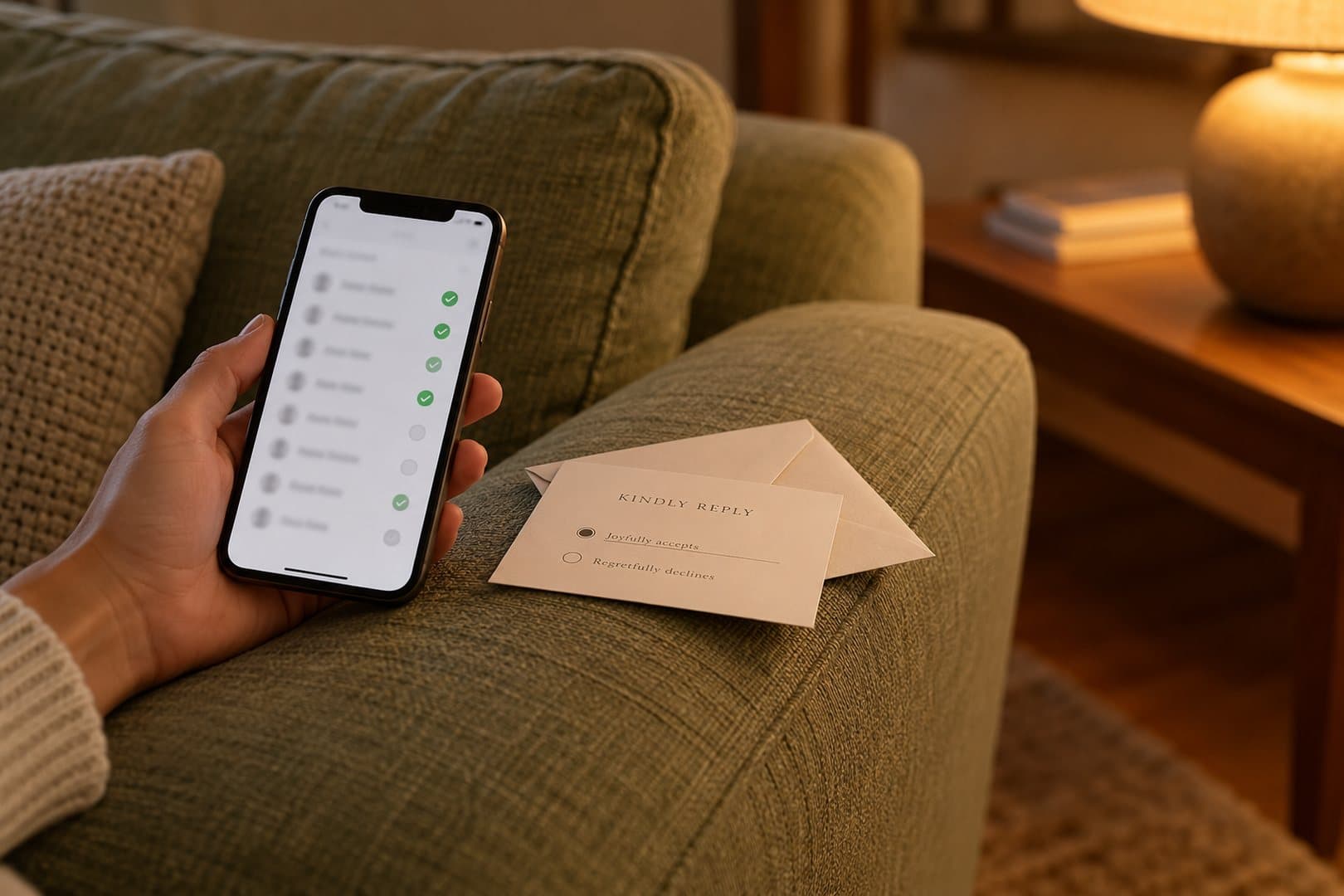
Here's the plan we'd use, timed against a 12-day buffer, with texts you can adapt. Send them from your own phone, in your own voice.
Step 1: Five days before the deadline
One light reminder by text to everyone who hasn't answered, with the link again.
“Hi Jordan, just a reminder that we're asking for replies by Sunday. Here's the link again so you don't have to dig for it: [link]”
Step 2: The day after the deadline
A personal text. You take your friends; a parent or partner takes the relatives closer to them.
“Hi Aunt Carol, we're finalizing numbers for the caterer this week and wanted to check whether you and Uncle Dev can make it. Here's the invitation: [link]. No pressure if you're still sorting out plans. Just let us know either way.”
Step 3: Four days after the deadline
A phone call. Some people miss texts, and a voice is harder to put off.
“Hi! We're calling because we'd really love to have you there, and we're getting our numbers together. Do you think you can make it?”
Step 4: A few days before the caterer's date
One last check, then decide how you'll count anyone you still can't reach and send the number on time.
“Hi Sam, we have to give our caterer the final count on Friday. Can you let us know by Wednesday whether you'll be there? We'd love to see you.”
Before the personal round, sort the list. You handle your own friends. Ask a parent or partner to reach the relatives who are closer to them. For a plus-one, ask the guest you invited, not their date.
Notice what these texts leave out: guilt, and the words "you forgot." Most people who miss a deadline meant to answer and lost track of it. Make the reply easy, and they'll usually take it.
A worked example
Here's a wedding on Saturday, September 16, 2028, with 90 guests and a caterer who needs the final count on Friday, September 1.
Saturday, September 16, 2028
90 guests, caterer count due Friday, September 1
- Sat8JulInvitation sent10 weeks before the wedding
- Tue15AugReminderA short text to anyone who hasn't replied
- Sun20AugRSVP deadline12 days before the caterer's date
- Mon21AugPersonal follow-upTexts to the guests still missing
- Thu24AugPhone callFor anyone who missed the texts
- Fri1SepFinal countThe number goes to your caterer, on time
Fourteen days before September 1 is a Friday. We moved the deadline to the following Sunday because it still leaves 12 days to follow up, and a weekend deadline is easier for guests to meet. With 100 guests or more, we'd stay at the full 14 days and use the Friday.
Start with your caterer's date
Write your RSVP date on the same day you sign the catering contract, while that page is still open. Count back 10 to 14 days, make it a Sunday if the math allows, and print the weekday on the card. Keep the reply to three questions at most, then put the reminder and the follow-ups on your calendar right away. That way the week after your deadline belongs to a few friendly texts instead of a worried spreadsheet.
When you're ready, you can create your invitation with Vowfly for free and start collecting replies the day you send it.